Diversification, Taxes, and the Role of Direct Indexing
- MyTimeEquity
- Jun 4
- 3 min read
Concentration risk rarely begins with a bad decision. It usually begins with a very good one.
A stock doubles, then doubles again, and what started as a modest allocation quietly becomes the dominant force in a portfolio. This happens in two common ways.
Investors have seen it play out vividly in the AI trade of 2025 and 2026. Memory stocks and AI infrastructure names: Micron, AMD, Samsung Electronics, delivered extraordinary returns for those who positioned early. What felt like a well-sized investment became, over time, an outsized exposure.
For others, the concentration builds more slowly. Company equity accumulates through years of stock grants and options, growing alongside a career until a single employer represents a disproportionate share of personal net worth.
In both cases, the problem isn't recognizing the risk. It's knowing what to do about it.
The Concentration Trap
Selling a highly appreciated position triggers capital gains taxes that can consume a meaningful portion of proceeds before a single dollar is reinvested. Holding avoids the immediate tax hit, but leaves the portfolio dangerously dependent on a handful of names. One earnings disappointment, one regulatory shift, one sector rotation and years of compounding can unravel quickly.
This is the concentration trap: the very success that created the position makes it expensive to exit. Most investors default to framing it as a binary choice; sell and pay, or hold and hope. Neither is a sound long-term strategy.
A More Efficient Path
Direct indexing changes the math.
Rather than liquidating a concentrated position outright, direct indexing allows investors to gradually reduce their exposure while simultaneously building diversification in a far more tax-efficient manner.
As a concentrated holding is gradually reduced, losses elsewhere in the portfolio can be harvested to offset a portion of the realized gains. The goal isn't tax elimination, it's making diversification less costly. Over time, the drag of transition shrinks, and capital moves more efficiently into a broader, more resilient portfolio.
Where Does Capital Go Next?
Reducing concentration is only the first problem. The second; often underappreciated, is what comes next and where to park the capital after reducing concentrated positions.
Once capital is freed from a concentrated position, it needs a clear destination: a portfolio structure aligned with the investor's risk profile, time horizon, and long-term goals. Without that, diversification becomes a half-measure.
How MyTimeEquity Approaches This
At MyTimeEquity (MTE), direct indexing is the foundation of how we help investors navigate this transition gradually, deliberately, and with tax efficiency built into every step. We offer a suite of three strategies, each designed around different risk profiles, allowing investors to move into the structure best suited to their objectives.
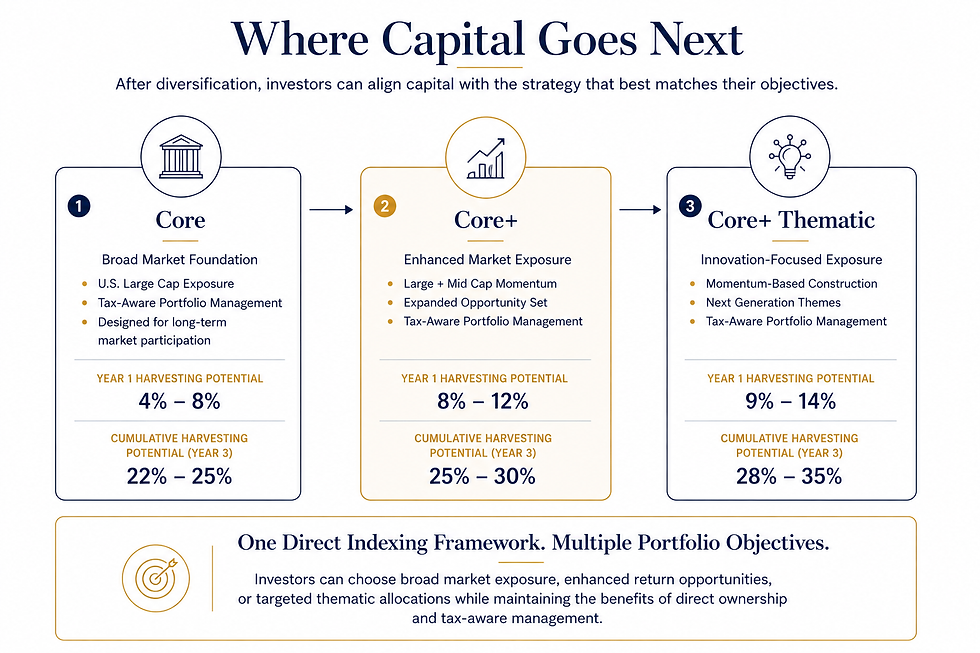
What makes our approach stand out is accessibility. Direct indexing has historically been the domain of ultrahigh-net-worth investors, carrying high minimums and fees that placed it out of reach for most. MTE offers this capability at some of the most competitive pricing in the industry with low minimums, making institutional-grade tax management available to a significantly broader range of clients.
The objective is straightforward: help investors move from single-stock dependency into a diversified, tax-aware portfolio, without letting the tax bill become the reason they don't act.
To learn more, email us at wealth@mytimeequity.com and we’ll set up a time to walk you through it. You can also join our WhatsApp group for ongoing updates and direct access to our team. Join the MyTimeEquity WhatsApp Group


Comments